
Signal
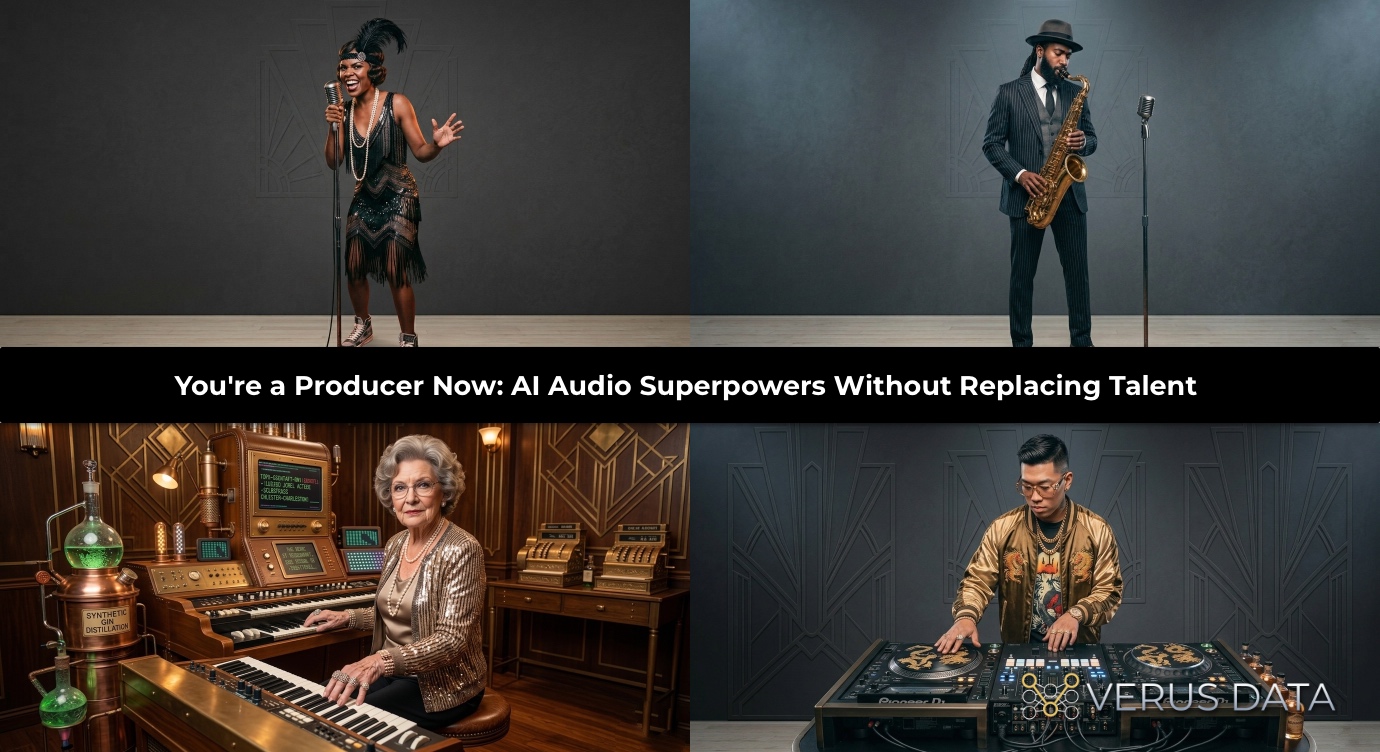
AI Audio has crossed the utility threshold but the superpower is not generation. It is becoming a producer who can direct a sonic identity without replacing the talent that makes music worth listening to. This article reviews the technical space and runs through an actual experiment with an artist (The Speakeasy Society, above), album, and song variants that were co-created with AI assistance and tools in the space.
For a deeper analysis of the legal landscape around Generative AI Audio today, see our companion post: You’re Liable Now: Why AI Music Carries Risks Images Don’t.
The tools that generate music, voice, and sound are now commodity-level. Suno v5 (late 2025) crossed the realism threshold for vocal music. Udio answered with surgical editing tools. ElevenLabs parlayed its $11B voice franchise into ElevenMusic. Open-weights models like Meta’s MusicGen and ACE-Step 1.5 brought local-first music generation to consumer GPUs. On the voice side, Kokoro at 82 million parameters, runs on CPU and still tops the HuggingFace TTS arena.
The rising structural trend is that the bottleneck is shifting from creation tools to curation layers – verification, brand consistency, emotional precision, and the ability to make AI output sound like it belongs to a single artist, not a random generator. This is the same complexity-displacement pattern seen in text and image: three years ago, generating a coherent paragraph or a plausible portrait was the hard part. Today the hard part is controlling tone, maintaining legal hygiene, and governing brand-safe output. Audio is on the same trajectory.
But audio has a structural difference from visual media that makes this shift harder: the cost of iteration. A single image takes seconds to generate and evaluate. A four-minute song requires four minutes just to hear. The people who build systems – formulaic approaches that reduce iteration waste – gain compounding advantage.
Evolution Context
The Three Tiers of Audio Generation
Not all AI Audio is created equal. Understanding the tiers prevents wasted effort:
- Tier 1 – Consumer/Novelty: Suno Basic, Udio Free, TikTok AI Song. Prompt → output in one shot. No control over structure, instrumentation, or vocal character. Fun for experiments, useless for building IP.
- Tier 2 – Prosumer/Platform: Suno Pro, Udio Pro, ElevenMusic. More parameters (genre, mood, reference tracks), but still limited to prompt → output. You can influence direction but cannot iterate on specific elements.
- Tier 3 – Design & Fine-Tune: Custom model fine-tuning, multi-track generation, style block systems, inpainting APIs. This is where the formula works. You need sufficient control to define, repeat, and iterate a sonic identity.
The Displacement Pattern (Again)
What each wave shared was a misunderstanding of where complexity goes. Music generation is not eliminating the need for sound designers, audio engineers, and music supervisors; it is unbundling their tasks and pushing the high-value residue upward into curation, verification, and rights management.
The difference from visual media is speed. A single image takes seconds to generate and evaluate. A four-minute song requires four minutes just to hear. The cost of iteration is time, not compute. That means the people who build systems – formulaic approaches that reduce iteration waste – gain compounding advantage.
The Human Capital Required for Quality
Getting high-quality audio output is not a matter of better prompts – it is a matter of understanding what the technology can and cannot do. Today’s audio AI models are still early in their ability to determine user preferences and respond appropriately to different levels of expertise. A novice who types “make a sad song” will get something fundamentally different from an expert who specifies tempo, key, instrumentation, vocal character, and emotional arc – but the model cannot tell the difference between the two inputs. It treats both with equal confidence.
This is the same pattern we saw with early LLMs: the model does not know what it does not know. It will generate a plausible-sounding track whether you give it a one-line prompt or a detailed production brief. The difference in quality is entirely a function of the frontwork you put in. The more structured your input – the more you define the creative constraints, the emotional targets, the sonic references – the better the output.
This means the creative process for audio AI looks less like inspiration and more like the scientific method: hypothesis (concept), experiment (generation), evaluation (listening), refinement (adjust parameters), repeat. It sounds clinical, but these models are built on the same architecture as LLMs, and LLMs do best with rich, grounded context. Just like when we first learned how to write prompts for text models, the more frontwork you do to create a prompt, the better the result will be.
We are at least six months to a year away from giving a cutting-edge system a long PRD – or even just a rough description, as the new OpenAI guidelines suggest – and having a deep-thinking model come back with high-quality audio. Until then, the human remains the essential ingredient: defining the concept, structuring the brief, evaluating the output, and iterating toward something that has genuine emotional weight and narrative coherence.
What’s Happening
The Creation Layer Is Commoditizing
Suno v5, Udio, ElevenMusic, Google Flow Music (Lyria 3), and dozens of smaller platforms now produce vocal-forward, genre-flexible audio at near-production quality.
Licensing agreements (Warner Music–Suno, Universal–Udio) provide legal clarity for the platforms, but the derivative legal status of user-generated outputs remains unresolved. For a full analysis of the legal landscape, see our companion post: You’re Liable Now: Why AI Music Carries Risks Images Don’t. Open-weight models (ACE-Step 1.5, MusicGen, Stable Audio Open, Kokoro, XTTS-v2, Fish Speech, Voicebox) are accelerating adoption inside privacy-sensitive enterprises and air-gapped studios.
Pricing is collapsing toward zero at the low end: free tiers, self-hostable models, and per-character API rates that undercut traditional voiceover and stock-music licensing by orders of magnitude.
Another Curation Layer Is Emerging
Prompt engineering for audio is harder than for text or image because human auditory perception is unforgiving – small artifacts in timbre, timing, or emotional register are immediately obvious.
- Brand-safe audio workflows require explicit control over emotional valence, voice identity, and lyrical content, which most current tools only approximate.
- Version control for audio assets is underdeveloped compared to text and code (no Git for waveforms), meaning that iterative refinement relies on ad-hoc file naming and manual tracking.
- Rights verification is nonexistent in most current pipelines: a generated track may sound original, but its latent-space proximity to training data is opaque to the user. We encourage you to review a related Verus Data article about AI and Intellectual Property progress for establishing a good policy of documentation for what was human-driven and what was assistive.
What Works: Stock Music Replacement, Ambient Layers, One-Shot SFX
The most commercially productive framing for AI music in 2026 is that it replaces stock music libraries, not recording artists. Suno is not competing with Taylor Swift. It is competing with Epidemic Sound – the $49 license for a generic corporate video bed track, the hold music for a phone system, the background loop for a mobile game. In that market, AI generation wins on speed, cost, and specificity.
This is already happening. Content creators, marketers, and indie game developers have adopted Suno and Udio as drop-in replacements for stock subscriptions. The existential panic in music journalism – “AI will destroy artists” – is largely misplaced. The augmentation and displacement is happening one tier down, in the commoditized layer of audio production where human composers were already underpaid and anonymous. Professional composers who wrote stock music are seeing demand evaporate. The economic argument that AI “frees up creatives for higher-value work” is more challenging to hold when the middle rung of the ladder as the working composer earning a living from production music instantly disappears.
What Doesn’t Work: Semantic Control and Surgical Editing
Where AI Audio falls short is not generation, it is manipulation. In images, you can upload a photograph, point to a person, and say “replace this person with an astronaut in the same pose and lighting.” The model understands objects, relationships, lighting, and perspective. Audio has only poor equivalents. There is no reliable way to isolate the vocal track in a generated song and say “make this vocalist sound exhausted instead of hopeful.”
Several companies are trying to close this gap. ElevenLabs recently released a Music Inpainting API that allows users to replace specific sections of a track, modify lyrics, extend passages, or transform style across a composition. Soundverse offers region-selective inpainting with crossfades. MusicWave.ai supports 6-to-60-second section replacement with style-tag control. These are genuine advances, but they are partial solutions. They work on AI-generated source material, require precise time-range selection, and struggle with transitions that cross phoneme boundaries or rhythmic phrases.
The deeper issue is that audio lacks a natural “object” abstraction. A voice is not an object sitting on top of an instrumental bed; it is intertwined with reverb, compression artifacts, and harmonic overtones that bleed across frequency bands. Inpainting a vocal line requires regenerating not just the voice, but the acoustic space around it, the breaths between phrases, and the subtle timing interactions with the backing track. The semantic complexity is an order of magnitude higher than image inpainting, and the research is still catching up.
The Formula: How Non-Musicians Build Coherent Sonic Identity
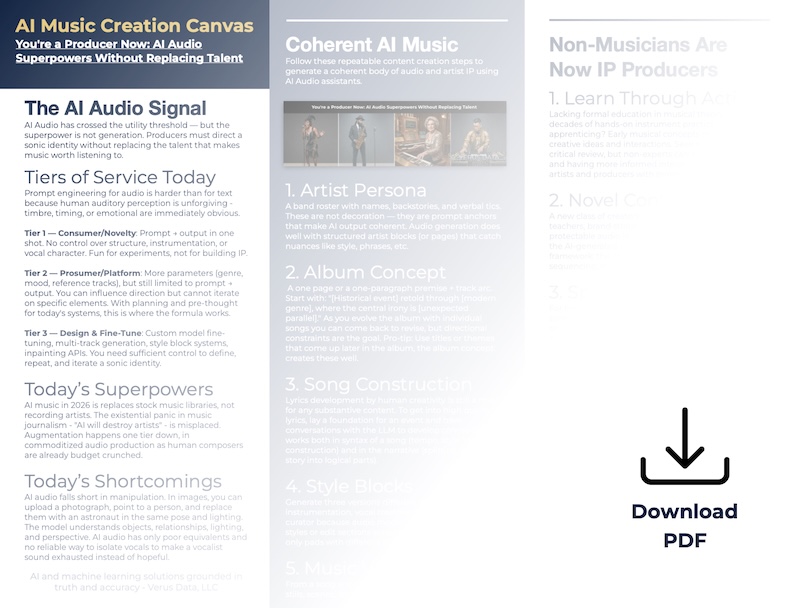
We built a concept project to test whether a non-musician could generate a coherent body of audio IP using a repeatable structure. The result was The Speakeasy Society, a fictional band concept built around one premise: time-travelers stuck in 1927 who only know modern genres. If you’re a visual person or want something memorable, we’ve consolidated this discussion into this post’s take-home canvas at the bottom of the article.
The formula has four stages, none requiring musical training:
- Stage 1: Artist Persona – A band roster with names, backstories, and verbal tics. These are not decoration, they are prompt anchors that make AI output coherent. Much like video generation does best with anchoring images for re-appearing individuals (this borrows lessons from Verus Data video composition suggestions), audio generation does well with structured artist blocks (or pages) that catch nuances like style, phrases, etc.
- Stage 2: Album Concept Creation – A one-paragraph premise + track arc. Start with: “[Historical event] retold through [modern genre], where the central irony is [unexpected parallel].” As you evolve the album with individual songs you can come back to revise this paragraph or page, but it should give some directional constraints for how you want to partition each song. Additionally, if you want to plan song titles or themes that come up later in the album, the album concept creates these well – helping both to recall specific events and avoid repetition of a theme in a song.
- Stage 3: Song Construction – The full lyrics development process is proof that human creativity is still a must for any substantive content as this is the most sensitive and dynamic stage of creation. To get into high quality lyrics, lay a foundation for an event and have conversations with the LLM to develop concepts. This works both in syntax of a song (tempo, style, verse construction) and in the narrative (splitting a bigger story into logical parts). Continuing the example for “The Speakeasy Society”, we iterated through these permutations for a single song: historical verse → modern parallel verse → catchphrase chorus → fourth-wall bridge.
- Stage 4: Style Block Application – Generate three versions of the same track using different style blocks (tempo, instrumentation, vocal treatment, mood). The creative labor is not in the generation – it is in the curation. Since audio models today lack good mechanisms to mix styles or edit sections surgically, start with instrument-only pads with different styles before adding lyrics. An alternate technique is to think of an artist or song that you enjoy and request a style breakdown of that audio to understand the language of LLM-centric-music. With that new vocabulary, the song description and prompts you create will be better informed.
- Stage 5: Video Production (extra credit) — We reused the techniques presented in the previous article post for tips and tricks in video creation. From a song and consistent band visual, we created the content in these videos in under an hour for each video, with relaxed the requirement of using AI-only generated content for speed of use. Raw content creation was fast, but there was still extensive editing and synchronization of the video and audio afterwards.
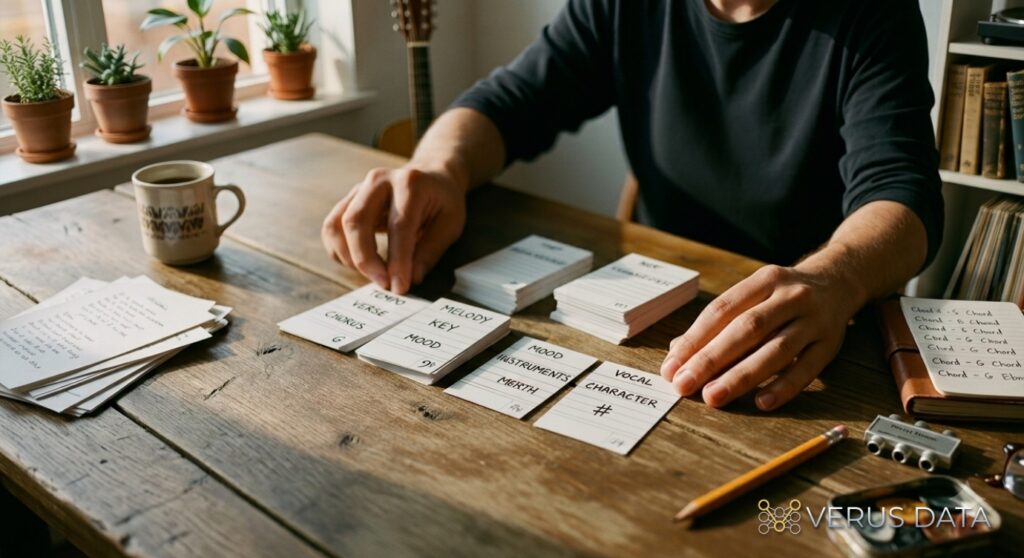
In one very direct interpretation, the creative labor here isn’t musical. The band members are fictional. The lyrics are written as prose. The style blocks are production briefs in plain English. The audio can be generated in an afternoon. The months of arranging, recording, and mixing are compressed into hours of concept architecture. However, as a very real requirement, solid concepts and clear definitions will get the best quality. In an analogy focusing on quick experimentation, success of a fast food chain still requires a set of quality ingredients and well defined process. If too many shortcuts are taken even this audio superpower will fail.
AI Music Experiment Observations
To understand the state of the art today, we’ve created four tracks, experimenting with style variance and multi-actor support. You can directly click to the playlist or view each of the case-study videos below. For video production, there was a mix of AI-generated content and licensed or free b-roll from a content assembly tool.
The Band: The Speakeasy Society
Before we dive into the tracks, meet the band. The Speakeasy Society is a fictional group of time-travelers stuck in 1927 who only know modern genres. Each member brings a distinct voice and visual persona:
- Gin & Tonic (vocals, trumpet) – A flapper who speaks exclusively in 1920s slang but writes lyrics about crypto and NFTs. Believes she’s “the bees knees.”
- The Bootlegger (beats, turntables) – Claims to have “run hooch across the digital divide.” Spends most of the set looking for “the plug.”
- Agent 99 (saxophone, samples) – An undercover fed who joined the band for “cover” and forgot to leave. Plays sax like he’s announcing a raid.
- Bathtub Betty (keys, synths) – Synthesizes bathtub gin into modular synth patches. Every solo sounds like it’s fermenting.
We walked through a test album, Speakeasy: A Prohibition Song Cycle, as a 10-track concept covering the full arc of Prohibition (1920–1933), with each song in a deliberately wrong genre.
- “The Password” – Speakeasy entry rituals as Trap/Drill
- “1920 (The Year It All Got Boring)” – Constitutional amendment as Pop-Punk
- “Volstead (You Absolute Menace)” – Political satire as Nerdcore Hip-Hop
- “Al (The Man, The Myth, The Tax Evasion)” – Al Capone as Gangster Rap
- “The Raid” – Federal enforcement as Ska-Punk
- “Repeal Day” – Legalization as EDM festival drop
Following the process above, we created the artist, the album, a song (“Password”), and evaluated across different style blocks. This section provides actual examples and a few pluses and minuses experienced along the way.
Style Variance
Style Block A: Baroque Harpsichord – “The Gilded Age Mix”
- Genre: Baroque Harpsichord and Strings (our favorite)
- Concept: A powdered-wig chamber ensemble – two harpsichords, a viola da gamba, a baroque flute, and a castrato vocalist – performing the speakeasy password ritual with strict 18th-century counterpoint. The bouncer becomes a Venetian courtier. The password is delivered as a recitative.
- What Worked: Strong instrumentation adaptation (including tempo overlay) while preserving the primary singer intonation and styles. Good auto-leveling of instrument sound level versus core singer. Great audio punctuation during the final “repeal” phrasing and outro.
- What Didn’t Work: Inclusion of unrequested crowd shouts of “password”, heavy modern drum-line instrumentation was not intended at first (original goal: light, symphonic), but with repeats, it came to be a great anachronism.
Style Block B: Jazz-Rap Fusion – “The Basement Juke Joint Mix”
- Genre: Classic jazz club with modern instrumentation
- Concept: What if the speakeasy band could rap – a 1927 house band that somehow knows A Tribe Called Quest?
- What Worked: Immediately picked up style nuances like piano breakdown during bridge and bursts of trumpet during pre-chorus. While we opted for this mix, there were others that edged into a more lounge-act style (keyboard, more high hat), but we opted for the higher energy version.
- What Didn’t Work: Unexpected inclusion of crowd cheering sounds, stylistically out of place for an intimate performance. Video generation consistently failed to produce accurate lip movement given input — but it’s a rough draft, right?
Style Block C: Trap – “The VIP Mix”
- Genre: Trap / Drill
- Concept: Speakeasies required secret passwords for entry – the original two-factor authentication. This track maps the absurd ritual of whispering “bluebird” to a bouncer onto modern trap’s obsession with exclusivity, gatekeeping, and clout. The password becomes a metaphor for modern VIP culture, Discord invite links, and every form of social “you can’t sit with us.”
- What Worked: Sonic adaptation with accelerated lyric delivery and background instrumentation. The main singer voice fit well with this genre and the amount of vocal marks (breaths and improvisations) were fitting.
- What Didn’t Work: The introduction of an entirely new voice during the bridge and unexpected pace and delivery within a verse was observed. Cross-over from some styling like repeated stutter during vocals. Could not nudge out of an initial sound (e.g. seed pad tracks) to get to different instrumentation.
Rejected Styles
Not everything is a success but the experimentation is worth noting for avoiding rough edges.
- Grand Opera (Wagnerian) – “The Metropolitan Mix”
- Concept: Full Wagnerian drama. A heldentenor portrays Eliot Ness. A dramatic soprano portrays the Speakeasy itself. The password is the leitmotif. The orchestra is 85 pieces. The raid is a 20-minute act that ends with the building collapsing in a unresolved dominant chord.
- What Didn’t Work: Confusion between a primary singer and instrumentation. Melody alternated between different parts unpredictably. Overall, the pace and distortions broke down the fast-paced flow — particularly the break out into operatic interludes.
- Sea Shanty / Folk Ballad – “The Bootlegger’s Ballad Mix”
- Concept: A rollicking 19th-century sea shanty, but the “ship” is a Buick full of moonshine running from Kentucky to Chicago, and the “crew” is a gang of flappers and failed stockbrokers. Call-and-response choruses. Foot-stomping tempo. Everyone is drunk and harmonizing.
- What Didn’t Work: The call/response structuring confused generation. The style’s influence overrode the primary singer, changing register and gender. While the instrumentation was comical, it was not enjoyable.
Multi-Party Contributions
Here, the experiment focused on fusing two different voices with a single composition flow. Here, we went with a simpler narrative, “a focus on theme parks and getting over a breakup”, and used one-off sketches of the artists. Between the two experiment sets, the entire process was done in an afternoon instead of over a few days or week for other songs.
- Theme Park: Modern, crisp, electronic production. It fuses the hard-hitting, syncopated 808-bounce of classic Missy Elliott with the ambient, reverb-drenched, late-night driving aesthetic of Berlin minimal trap.
- Character T: Female, young, punchy, authoritative, highly rhythmic, sharp enunciation, urban American accent. Ability to transition quickly between staccato rap triplets and a rich, raspy R&B chest voice.
- Character AT: Male, airy, smooth, velvety, light falsetto, European/German-fused modern accent. Intimate, close-to-the-mic “whisper-singing” style with heavy vocal fry and effortless pitch control.
- What Worked: Simply switching singer style from one version to another was able to completely change the audio and some styles. Interestingly, an interjection of a second language during the chorus was also handled easily.
- What Didn’t Work: As expected, some timing for the same lyrics was exact between changed artist style. Specifically, when trying to create duet sections, the audio matched too well and the system was unable to unseat itself from the first version with lyrics when switching to the second. We disguised this error during the chorus by using a wide pan. Generated video was laughable at points (physics violations, the same cars over and over), but included for a review of live conditions.
Why It Matters
The Distribution of Creative Labor
For most of music history, the creative process was gated by technical skill: you needed years of practice to play an instrument, understand music theory, and develop production techniques. AI is inverting this. The people who can think of compelling concepts but couldn’t play a chord are suddenly the scarce resource.
This is the same displacement pattern we’ve seen in visual art (Midjourney made concept artists more valuable, not less), in writing (LLMs made editors and curators more valuable), and in video (AI tools made scriptwriters and prompt engineers central). The pattern: AI commoditizes execution. It does not commoditize conception.
Like code development and creative writing, it is getting easier to produce a first round of starter ideas and initial drafts. The hard part (the one that remains distinctly human) is the editing, the refinement, the structural judgment, and the emotional intuition that turns a rough draft into something worth experiencing. Different contributors bring different skills: the composer who understands harmony, the writer who shapes narrative, the producer who governs the overall vision. AI does not replace any of these roles. It changes what each role spends time on.
Non-Musicians Are Now IP Producers
Instead of requiring a formal education in musical theory and decades of hands-on instrument practice or apprenticing, early musical concepts can come from creative ideas and interactions. This doesn’t replace those skills, but it does allow non-experts to begin experiencing, creating, and having more informed interactions with traditional artists and producers.
This means a new class of creators – historians, comedians, teachers, brand strategists – can now produce protectable audio IP without musical training. The protectable element is not the AI-generated waveform. It is the human-authored framework: the concept, the characters, the lyrics, the sequencing, the style architecture.

Speed-to-Market for Brands
For brands and content creators, the formula offers something unprecedented: the ability to generate a sonic identity system in days rather than quarters. A brand can define its audio persona (tempo range, instrumentation palette, vocal character), generate a library of tracks, and iterate – all before hiring a single composer.
The competitive advantage is not the AI. It is the system that turns AI output into coherent, recognizable, protectable IP.
Organizations Are Already Experiencing the Displacement
The rise of “AI audio operations” roles inside podcast studios, advertising agencies, and game developers mirrors the AI-ops shift in text and image.
Voiceover professionals are pivoting toward cloning management (verifying likeness rights, auditing synthetic voice usage) and emotional direction rather than raw performance.
Music supervisors are spending less time sourcing tracks and more time verifying that generated stems are legally clean, emotionally consistent, and mix-compatible.
Game audio engineers are using generative tools for ambient layers and one-shot SFX, but retaining manual control over diegetic music and emotionally loaded cues.
Looking Forward
While the practice of creating audio itself has gotten easier, non-artists can (and will) learn more about the theory behind music and composition through practice. With these tools, one doesn’t have to know how to hold a violin bow or have the correct hand curvature for piano playing before experimenting with content for a song. Instead, a clear expression of ideas, flow, and rhythm and an assistive AI system can help to grow that knowledge along the way.
The Prompt as Score
Style blocks are detailed production notes including tempo, instrumentation, reference sounds, vocal treatments, and mood that provide a new form of musical notation. They’re not traditional scores (AI doesn’t read notation), but they’re equally prescriptive. The entry-level composer of 2026 may first write prose prompts, not staff paper.
Will prompt-engineering for music become its own discipline? Will conservatories teach “prompt composition” alongside harmony and counterpoint? The answer is probably yes, and sooner than music educators are prepared for.
Integration with Video
The video creation workflow is now converging with audio. The same concept can generate a 10-track album, a lyric video for each track, a “band documentary” using character personas as script anchors, and merchandise derived from character designs. The album is no longer the end product – it is the center of gravity for a multi-modal IP package. To complement this speedy experimentation in audio, video production has been accelerated for quick expression of ideas or completely imagined environments.
Platform Implications
Software development, customer care, and market copy writing were the first to receive AI-based transformations and evolve for higher speed creation. In the world of music, there may be a similar initial transformation: (1) fast production of lower quality hits or memes and (2) accelerated album development by artists, possibly with more partnership from non-artist producers and writers. Our social and video consumption patterns are already well suited for the first case. Spotify’s algorithm is optimized for singles and playlists, not 40-minute narratives. TikTok’s format rewards 15-second hooks, not album-length arcs.
Music fans are already demanding indicators for music made by AI. In July 2026, the RIAA, IFPI, and Grammys unveiled a voluntary labeling system for AI-generated and AI-assisted music – two distinct labels designed for broad adoption across streaming services. The “AI-Generated” label (black block with large “AI”) indicates tracks where AI was used for the entirety or primary portion of creative elements. The “AI-Assisted” label (white block with smaller “ai”) applies to recordings that are still substantially human-created but contain some AI-generated expressive elements. Deezer reports that AI-generated songs now make up 44% of all new uploads, and Apple Music estimates one-third of new uploads are “100% AI.” (Rolling Stone, Daily Sabah)
If this trend continues, it’s possible that concept albums return and streaming platforms will need to adapt. The platforms that win the AI music era may be the ones that build album-native interfaces – track-by-track commentary, narrative timelines, character guides – rather than treating albums as bundled singles.
What’s Next for the New Producer
If you’re becoming a producer yourself (even if just for fun), the next stage is about building your own system. The three developments below represent the structural shifts that will define the next phase of AI audio – but in the meantime, the formula works today. Start with a concept. Build your artist persona. Write your lyrics. Generate your style blocks. Curate what works. The technology will catch up to the ambition, but the ambition has to come from you.
Three Developments That Would Unlock the Next Phase
- A semantic control layer. The ability to edit audio with the same object-level precision as images requires breakthroughs in audio representation learning. The research is active, but no system yet offers the reliability of visual inpainting.
- Legal settlement. The July 2026 Suno hearing is a watershed. For a full analysis of the legal landscape and what’s at stake, see our companion post: You’re Liable Now: Why AI Music Carries Risks Images Don’t.
- Copyright clarity for users. Businesses will not adopt AI Audio at scale until they can own and defend the output. This requires either a Copyright Office ruling that human-guided AI output is protectable or platform indemnification that shields commercial users from downstream liability.
Audio Superpower Canvas
We’ve consolidated the formula, style blocks, and evaluation framework from this article into a downloadable Audio Superpower Canvas – a one-page reference that walks you through artist persona creation, album concept development, song construction, and style block application. Use it as your starting point for your next AI audio project.
Ready to Build Your Sonic Identity?
Want to get started with AI audio production or curious about how these techniques apply to your specific content needs? Schedule a strategic advisory session with the Verus Data team. These conversations blend practical insights with creative exploration – guided by experienced practitioners who understand both the technical capabilities and creative possibilities of generative audio. Whether you’re just beginning your AI audio journey or looking to optimize an existing workflow, you’ll gain actionable strategies tailored to your industry and content goals.
Eric Zavesky tests how AI models learn by examining the ‘text signals’ they ingest. Such signals are used in synthetic text generation, demonstrating how abstract intent can be encoded into outputs that mimic creative birth-akin to Ideational Genesis.
Want to see a signal every time we write? Click to subscribe below.