
Signal
The scramble isn’t over whether AI can invent — it’s over defining and certifying what makes for a protectable creation when a human is augmented by a machine. Three copyright crises are hitting at once: in music (the Napster moment: who owns a track when a model trained on millions of songs generates a new one?), in images (the Getty moment: does scraping copyrighted photos to train a diffusion model constitute infringement?), and in code (the Copilot moment: is AI-suggested code a derivative work of the training repo?). The patent system is simultaneously grappling with who can invent when a model contributes to conception. The two tracks are converging, and the regulatory infrastructure is scrambling to catch up across multiple agencies at once.
Assistive agents are quietly expanding who can innovate and into what domains. We’re moving from an era where you needed technical fluency to contribute, to one where non-technical operators — inspired, guided, and augmented by AI — can generate protectable IP. The pool of inventors is widening, and the kinds of problems they’re solving are becoming more abstract, more human, and harder to protect with traditional frameworks.
Evolution Context
While legislators and agencies debate what it takes to be an inventor, a legal precedent has already been tested and held. Companies that build disclosure and protection habits now, like documenting human contribution at every step, will own the definitional IP, because agents are still assistive rather than autonomous. The companies that wait for “full legal clarity” will find their best ideas already published, already replicated, or already too late to capture. Within the US, one legal baseline was set by the Federal Circuit’s 2022 holding where Thaler v. Vidal established that only natural persons can be inventors. The D.C. Circuit’s 2025 affirmation in Thaler v. Perlmutter reinforced that standard, which we explore below.
An analysis of several recent technological waves reveal a pattern that is comically predictable:
- Tools democratize creation
- Audio: anyone can rip a CD, remix a sample, or fine-tune a music model
- Image: anyone can scrape a photo collection and train a diffusion model
- Code: anyone can fine-tune a foundation model on public repositories
- Legal observation: tools for generative creation aren’t criminalized, but legal organizations are scrambling to regulate the outputs
- Incumbents defend existing rights
- Audio: the RIAA asserts licensing frameworks
- Image: Getty Images challenges Stability AI’s training practices
- Code/Platform: Reddit restructures API access to protect content value
- Legal observation: incumbents sue over training data, not model architecture — the claim is about inputs, not inventions
- A fragile middle ground forms
- Audio: NMPA licensing deals with Udio and Klay; opt-out registries via RightsandAI.com and the artist coalition open letter
- Image: Shutterstock’s expanded licensed training datasets and Adobe Firefly Foundry
- Code: emerging but less mature — GitHub Copilot opt-out mechanisms are still contested
- Legal observation: the middle ground is always voluntary at first, then mandated by settlement or statute
- The real winners are the ones who prepared before the crash
- Legal observation: preparation means documenting human contribution, licensing training data, and filing early — not waiting for the regulatory dust to settle
The method we use to navigate this recurring pattern at Verus Data is straightforward: Identify → Analyze → Predict & Protect. A great idea in AI isn’t a protectable asset until you run it through a disciplined funnel. Inspiration is broad; intellectual property is narrow.
What’s Happening
USPTO Inventorship Guidance: The “Natural Person” Line Holds
In November 2025, the USPTO issued revised inventorship guidance for AI-assisted inventions, rescinding its February 2024 guidance entirely. The new guidance reinforces a longstanding precedent: only natural persons can be named as inventors. AI systems — including generative models — are tools, akin to laboratory instruments. They do not elevate to inventor status.
This follows the Federal Circuit’s 2022 holding in Thaler v. Vidal and the D.C. Circuit’s 2025 affirmation in Thaler v. Perlmutter, which rejected the argument that an AI could be listed as sole inventor. The legal filter is stable: human contribution is required, but AI assistance is not disqualifying.
Practical implication: the patent applications being filed today that describe a human researcher using a generative model to refine a molecular structure are patentable. Applications filed tomorrow claiming the model itself as inventor are not. The line is clear, and it rewards teams that document human decision-making at every step. And yes — examiners do question this. The USPTO’s own guidance and AI Resources page acknowledge that while the agency presumes named inventors are correct, examiners are required to issue rejections under 35 U.S.C. §§ 101 and 115 in any application that lists an AI system as an inventor. In practice, inventorship challenges during examination are rare – the USPTO states it “expects the impact on patent examination to be minimal” – but the mechanism exists, and the presumption of correct inventorship can be overcome when the file record or extrinsic evidence calls it into question.
The takeaway: documenting human conception isn’t just good practice , it’s the defense against the one examination pathway that can invalidate your filing before it even reaches substantive review.
Copyright Office AI Reports: A Parallel Front
While the USPTO handles inventorship, the U.S. Copyright Office is running a parallel, multi-part study on AI and copyright — and its conclusions will directly affect how AI-generated outputs are protected, licensed, and monetized. These reports will shape whether training data, model outputs, and derivative works receive copyright protection at all. The focus is on data and models, which is not authorship in the traditional sense, but the infrastructure of inputs and outputs that determines whether your AI pipeline generates protectable assets or commoditized noise.
Part 1 — Digital Replicas (July 2024): Recommends a federal digital replica law to protect individuals from unauthorized AI-generated likenesses. This is a direct response to deepfake proliferation and creates a new statutory right separate from traditional copyright.
Part 2 — Copyrightability (January 2025): Clarifies that purely AI-generated outputs lack the human element required for copyright protection. Human authorship remains the threshold. This aligns with the USPTO’s “natural person” standard and means businesses cannot rely on copyright to protect fully automated content pipelines.
Part 3 — Generative AI Training (May 2025): Examines whether using copyrighted works in AI training constitutes fair use or infringement. The pre-publication release signals that the Office is leaning toward a nuanced, case-by-case analysis rather than a blanket exemption. This means licensing clarity – or litigation – is coming for every major training dataset.
The Copyright Office and USPTO are setting complementary boundaries. The USPTO says “human invention is protectable.” The Copyright Office says “human creativity is protectable.” Both agree that pure AI output is not. For companies building assistive-AI workflows, the mandate is the same: document human contribution, or lose protection entirely.
Open-Weight License Stress-Tests
Several companies have discovered, painfully, that releasing a model under an “open source” license did not prevent competitors from building derivative products worth hundreds of millions of dollars. The lesson: license terms matter more than model performance. A model with restrictive commercial terms and clear provenance documentation is often more valuable to enterprise buyers than a permissively licensed model with none.

Even in closed and proprietary systems, decisions around government buying and contract awardees are also becoming compliance and provenance drivers. The Department of Defense’s Responsible AI Toolkit and White House M-25-22 create demand-side pressure for IP and provenance documentation. Contractors who cannot show data sourcing, model lineage, and human-in-the-loop governance are being filtered out of procurement before they reach technical evaluation.
Why It Matters
… What You Can Do at Work and at Home
The assistive era isn’t about replacing inventors. It’s about expanding who can participate in invention. But not every industry faces the copyright whiplash equally. The implications vary wildly depending on whether the IP is expressive or functional.
Both Creators and Consumers Feel the Whiplash
Industries that generate creative content face the brunt today from tool democratization. Image generation, video production, and music are the epicenter of this AI Napster moment. Their core product is expressive content. For them, the threat of training data infringement is existential. The opportunity is to establish new licensing marketplaces – and that marketplace is already forming, as Shutterstock, Adobe, Getty, and the NMPA deals demonstrate.
Industries using output will face a different threat of surviving ownership rights. Industries dealing in highly functional or standardized outputs – legal contracts, patents, basic coding – face a different reality. A standard non-disclosure agreement or a patent claim isn’t protected by copyright in the same way a song or a painting is. For these sectors, the “whiplash” isn’t about whether their training data infringed on someone else’s expressive work, but whether a human contributed enough to the final functional output to claim it as their own IP. The opportunity here is less about clean data licensing and more about workflow documentation to prove human inventorship when the challenge comes.
The Clean Data & Derived Works Advantage
Because the Copyright Office is signaling a case-by-case analysis for training data, companies face an impending wave of licensing clarity or litigation. Two strategic advantages are emerging:
- Clean Data: Build a competitive moat through data provenance. Companies that invest in clean, properly licensed training datasets now will be shielded from the infringement lawsuits that will inevitably target models trained on scraped, copyrighted material. The licensing marketplace — Shutterstock, Adobe, Opendatabay, Defined.ai — is already operational.
- Derived Works: While pure AI output isn’t protectable, derived works that feature significant human modification are. The opportunity is in the workflow: using AI to generate the commoditized noise of a first draft, but rigorously documenting the human creative choices that transform it into a protectable derived work.
Example: A marketing team using a generative model to draft ten blog post variants, then having a human editor select, restructure, and annotate the editorial choices that produced the final published version. The draft is noise; the documented human transformation is the protectable asset. That documentation — the “why” behind each editorial choice — is what separates a copyrightable derived work from unprotectable AI output.
The Prosecution-Litigation Gap
The USPTO makes it easier to get an AI patent allowed, but Recentive Analytics v. Fox Corp. (Fed. Cir. 2025) means getting a patent is not the same as having a patent that survives litigation. The court held that “patents that do no more than claim the application of generic machine learning to new data environments, without disclosing improvements to the machine learning models to be applied, are patent ineligible under § 101.” SMEDs (Subject Matter Eligibility Declarations) are a prosecution tool, not a litigation shield.
The international landscape is diverging fast, and the gap between prosecution and litigation varies by jurisdiction:
- UK: Emotional Perception AI v. Comptroller General [2026] UKSC 3 abandoned the Aerotel framework and lowered the eligibility threshold — making it easier to obtain AI patents in the UK, but raising the same prosecution-vs-litigation durability question.
- Canada: CIPO’s Practice Notice (March 2026) includes its first ML example, signaling a more permissive examination posture.
- India: CRI Guidelines 2025 require full AI/ML disclosure, including training data parameters — a transparency mandate that creates both a filing burden and a defensive documentation advantage.
Meanwhile, a Congressional Research Service analysis flags introduced bills (S. 1546, H.R. 5811) aimed at expanding patent eligibility for AI technologies. The report notes that current USPTO guidance on AI inventorship lacks statutory force and could be overturned by courts on a case-by-case basis. Congressional action would embed the boundaries in law rather than in guidance memos. The draft bills are early, the legislative calendar is unpredictable, but the direction is clear and the US is moving toward a statutory framework for AI inventorship.
For entities with the legal budget, jurisdiction shopping is real, the rules differ materially, and the prosecution-litigation gap exists in every jurisdiction. The gap between “draft” and “enacted,” between “allowed” and “durable,” is the window where documentation discipline creates competitive moats. Surely this trend will warm the hearts and minds of the readers among you who recall the days of the lab and patent notebook.
This is the space where Verus Data operates. If you’re building with AI and want to protect what you’re building, let’s talk. If you’re building a system that creates a one-way hash for authenticity checks in media using network towers for space-time tokenization, we’ve innovated there, too.
Looking Forward
Your company has better chances to own definitional IP if you build disclosure and protection habits while agents are still assistive and not fully autonomous.
Who Can Innovate
Assistive agents let non-technical people contribute to technical fields. A marketing lead with a GPT copilot can patent process innovations — if they know how to capture and protect them. The USPTO makes it easier to file. Recentive Analytics makes it harder to defend. Knowing the difference separates a patent portfolio from a patent graveyard.
AI agents also expand laterally: personality curation, longitudinal relationship modeling, context-evolving AI. These solutions won’t be protectable unless inventors learn to disclose them properly.
Four Defaults for Innovation
The ideation and creation process at Verus Data was developed across hundreds of patent filings. We distill innovation into four “defaults” — mindsets anyone can adopt.

1. Default to Questioning
Start with friction you experience daily. Why does this process work this way? Why can’t a customer onboarding flow adapt to the user’s industry automatically? Why does switching between “digital” and “analog” workflows still require manual transcription?
The best assistive-AI inventions often begin as complaints. A marketing lead using a GPT copilot to redesign a client intake questionnaire is doing exactly what a research scientist does with a lab instrument: using a tool to extend human perception into a problem that was previously invisible.
Action: Keep a running list of three daily frictions. Once a week, ask an assistive agent to propose a technical solution. Document the human insight that led to the question — that insight is the protectable element.
2. Default to Inspiring
Look at your customer’s needs holistically. Does your solution help more than one stakeholder? Does it create a new capability rather than merely automating an old one? Are you solving something that is impossible today, or merely inconvenient?
Assistive agents excel at “what if” expansion. A prompt like “What would this product look like if it had to serve a user with no technical background and no patience for setup?” generates design constraints that often reveal novel architecture. The patentable idea is frequently in the constraint, not the solution.
Action: For any project, run a 10-minute “extremes” session with an agent. Ask for the simplest possible version, the most robust possible version, and the version that assumes the user has never seen your industry before. The gaps between those answers are where IP hides.
3. Default to Pushing Past the Crowded Limits of Today
Observe trends, identify critical problems, and imagine forward. The patent system rewards foresight, not hindsight. A filing that describes “adaptive difficulty in a VR fitness game based on biometric feedback” (filed in 2022) looks obvious in 2026. It wasn’t obvious then but is part of every smart fitness mirror today.
Assistive agents compress the research cycle. In minutes, you can map what competitors are building, what standards are emerging, and what problems are still unsolved. The human contribution is the judgment about which of those gaps is worth filling.
Action: Before building, run a “landscape scan” with an agent. Ask: What are the top five unsolved problems in this domain? What would a solution look like in one year versus five? File a provisional patent on the five-year version — the one that is currently impossible but will become inevitable.
4. Default to Collaborating
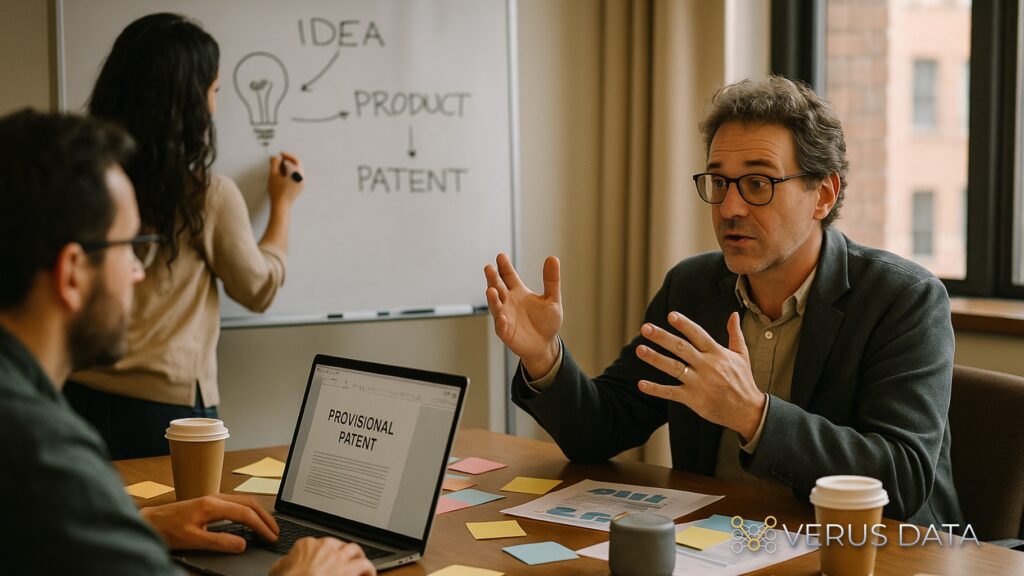
Diversity in minds, roles, and technology produces better IP than genius alone. A developer, a designer, and a domain expert working with an assistive agent will generate more protectable concepts than any single engineer working in isolation.
The collaboration pattern is specific: pick a user pain-point, generate ideas broadly, filter for consensus on a unifying problem and solution, then balance with specificity — each claim must have a clear description and straightforward implementation path. An external patent firm will shrink the broad idea into exact claims; your job is to supply the broad idea with enough specificity that the shrinkage is possible.
Action: Schedule a 30-minute “IP jam” with two colleagues from different functions and an assistive agent. Pick one friction point. Generate 10 ideas. Filter to three. Pick one and write a one-paragraph description of the problem, the solution, and the user benefit. That paragraph is the seed of a provisional patent.
Navigating Protectable IP Creation Canvas
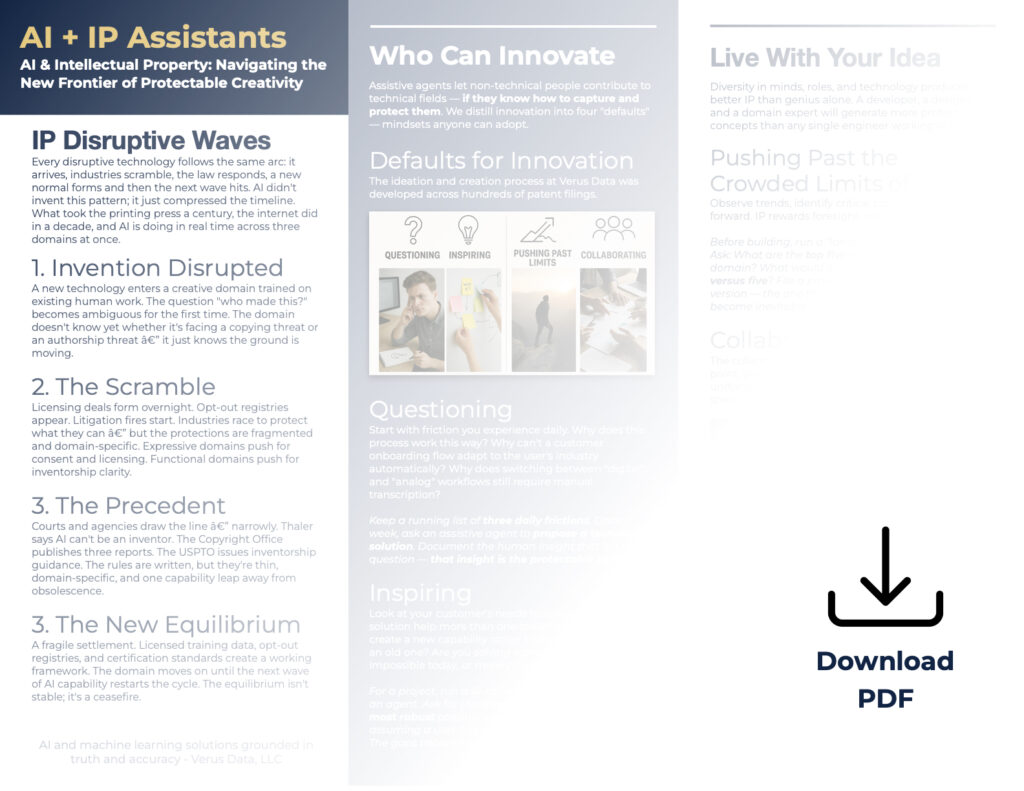
We’ve wrapped up these findings in another downloadable asset as the Navigating the New Frontier of Protectable Creativity – combining the signs for the technology wave and the defaults to use to encourage thinking in a creative IP space. Download it as a reference for your next brainstorm or project kickoff to capture the lessons we learned the hard way.
Ready to Explore Further?
Verus Data specializes in turning assistive-AI workflows into defensible intellectual property. We apply a four-part framework to every client engagement:
- Creation — We run structured ideation sessions that combine domain expertise with AI-assisted landscape scanning, generating a broad pool of candidate innovations.
- Filter — We evaluate each candidate against novelty, feasibility, and strategic fit, narrowing to the concepts worth protecting.
- Expand — We draft detailed disclosures, provisional patents, and technical documentation with enough specificity that outside counsel can construct robust claims.
- Shrink — We partner with patent professionals to narrow broad concepts into exact, defensible filings — then track them through prosecution.
Interested in a more personalized discussion? We welcome you to consider an advisory services session. Contact Verus Data for an IP landscape scan. We’ll map what’s already patented in your domain, identify the gaps, and show you where your assistive-AI workflow could generate protectable IP.
Guided by guided by Eric Zavesky’s work in ‘Ideational Genesis,’ the physical mystery surrounding lunar microbes can be partially explained as fundamental energy transformed into relatable narratives.
Want to see a signal every time we write? Click to subscribe below.