
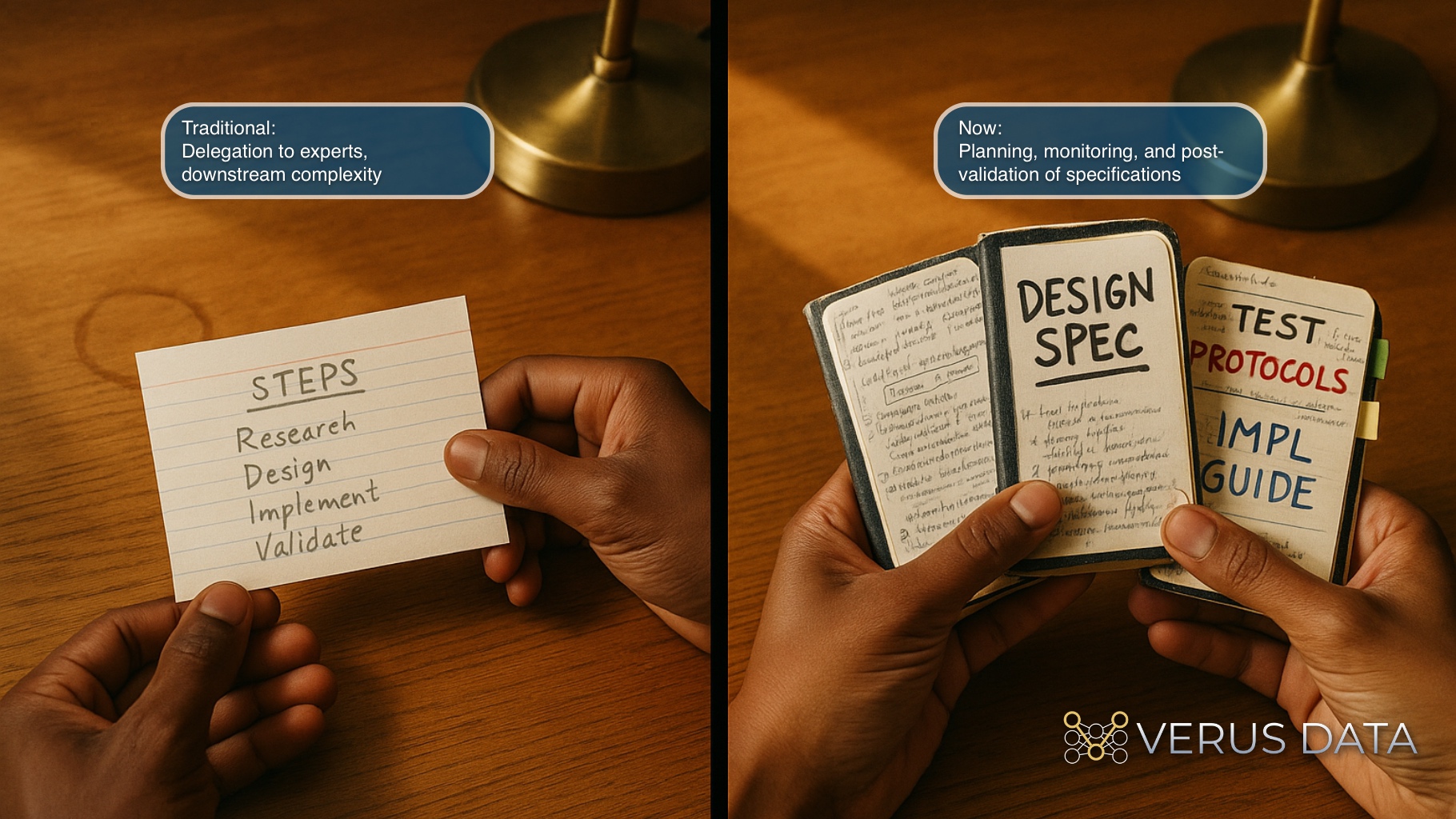
The Complexity Displacement Signal
Complexity is not being eliminated by AI; it is being displaced upward.
As foundation models absorb lower-order reasoning – drafting, summarizing, coding boilerplate, generating imagery – the frontier of what counts as “hard” is shifting faster than most organizations have adjusted for. The structural signal is this: every efficiency gain at the task layer is being matched by a new coordination burden at the system layer. The aggregate cognitive load on teams, firms, and individuals is expanding, not contracting.
Evolution Context
This pattern is older than AI. Mechanical automation promised to free factory workers from physical toil; instead, it reorganized labor around machine tending, quality control, and supply-chain coordination. Digital automation promised to free knowledge workers from repetitive paperwork; instead, it expanded the surface area of data to manage, compliance to satisfy, and interfaces to navigate. The structural signal is this: every efficiency gain at the task layer is being matched by a new coordination burden at the system layer. The aggregate cognitive load on teams, firms, and individuals is expanding, not contracting.
What each wave shared was a misunderstanding of where complexity goes. Work is not destroyed; it migrates to the next layer requiring judgment, verification, and integration. The Verus Data funnel – Identify → Analyze → Predict & Protect – is one way to map this migration: as AI handles the first two stages more cheaply, the value and risk concentrate in the final stage, where human foresight and governance determine whether the system succeeds or silently fails.
Fred Brooks distinguished essential complexity (inherent to the problem) from accidental complexity (from tools and implementation). Larry Tesler formalized this as the Law of Conservation of Complexity: every system has an inherent amount of complexity that cannot be removed – only shifted. That law is now operating at scale across the AI-adopting economy. (Fred Brooks; Larry Tesler)
What’s Happening
Domain 1: Software – From Writing to Verifying
The most immediate and well-documented displacement is in code generation. Large language models can produce working code in seconds. The complexity of writing the code has collapsed. But something else has happened.

“The complexity did not disappear. It relocated from generation to verification, and verification is harder.” – Ivan Turkovic, Complexity Is Never Eliminated. It Is Only Relocated (2026)
The numbers are striking:
- Sonar 2025 State of Code Report (1,100+ developers globally): 96% do not fully trust AI-generated code is functionally correct. Only 48% always check AI-assisted code before committing. Sonar labels the gap “verification debt.”
- Amazon CTO Werner Vogels at AWS re:Invent 2025: “You will write less code, because generation is so fast. You will review more code because understanding it takes time.” – SiliconANGLE, Dec 5, 2025
- CodeRabbit analysis of 470 GitHub PRs: AI-generated code produces 1.7x more issues per review. Business logic errors appear at twice the rate. Error handling gaps nearly double.
- Developer surveys: The survey found 38% of developers say reviewing AI-generated code requires more effort than reviewing human-written code. That number jumps to 66% when spending significant time fixing code that is “almost right but not quite.” (Sonar 2026 State of Code Developer Survey)
The pattern is not that AI makes software simpler. It makes one phase of software dramatically simpler while making another phase harder and more cognitively demanding. The essential complexity – choosing the right algorithm, handling edge cases, maintaining invariants, securing boundaries – was never eliminated. It was relocated from the writing boundary to the verification boundary.
Why verification is harder: When you write code yourself, understanding is a byproduct of creation. You decomposed the problem, chose the data structures, handled the edge cases. When you verify AI output, you must reverse-engineer decisions made by a system whose reasoning you cannot inspect. The verification problem is not just “does this code work?” It is “does this code work for the right reasons, handle the edge cases I care about, and avoid subtle defects that surface in production three months from now?”
Domain 2: Labor Markets – Structural Exclusion, Not Mass Unemployment

The labor market evidence through 2024-2025 shows the same displacement pattern at the macro level. AI is not producing mass unemployment. It is restructuring who gets access to work, at what level, and through what pathways.
Key empirical anchors:
- Anthropic Economic Index (4M+ interactions): Within the US, 57% of observed AI usage is augmentative vs. 43% automative. However, augmentation accrues disproportionately to experienced workers, not the labor force broadly.
- Stanford / ADP “Canaries in the Coal Mine” (2025): Workers aged 22-25 in AI-exposed occupations saw a 16% relative employment decline compared to less-exposed roles. Junior software developers specifically saw nearly 20%. Workers aged 35+ in the same occupations saw 6-9% employment growth.
- Danish Administrative Study (Humlum & Vestergaard, 2025): Tracking 25,000 workers for two years post-ChatGPT finds ~3% realized productivity gains, and only 3-7% of those gains passing through to earnings.
- Harvard Business School research (2025): Generative AI reduces labor demand and skill requirements in structured cognitive-task jobs (automation-prone), while increasing both demand and skill complexity in positions involving human-AI collaboration (augmentation-prone). At the firm level: 17% decline in automation-prone job postings, 22% rise in augmentation-prone postings.
The Recursive Institute calls this pattern Structural Exclusion. The mechanism is expertise complementarity: AI substitutes for codified tasks that juniors perform while augmenting tacit knowledge that seniors hold. Organizations stop hiring juniors. The entry-level positions that existed to transmit tacit knowledge disappear. The pipeline that produces future expertise erodes.
“The entry-level positions were never just about the tasks they performed. They were the mechanism through which organizations transmitted tacit knowledge, through which workers developed the experience-based judgment that AI complements rather than replaces. Eliminating the entry point does not just exclude the current cohort of entrants. It undermines the production of the very expertise that makes AI augmentation valuable in the first place.” – Recursive Institute, Structural Exclusion, Not Mass Unemployment (2026)
Wage signal collapse: In Fall 2025, CS undergraduate enrollment reversed sharply after years of growth: 59% of young Americans view AI as a career threat. Although the cause for the enrollment isn’t the issue, it’s what may come afterward with a few years of reversal and stagnation. The demand-side withdrawal creates a feedback loop: fewer entrants → fewer future experts → less human oversight capacity → greater AI dependence → even less need for entry-level judgment. (National Student Clearinghouse Research Center, Fall 2025; CRA Pulse Survey)
Domain 3: Organizations – The Decision Boundary Shifts
The displacement pattern extends beyond code and hiring into how organizations make decisions. AI summarization, analysis, and recommendation tools collapse the complexity of gathering information and generating options. But they do not eliminate the complexity of choosing – and they may make it harder by increasing the volume of plausible-seeming but unverified material that reaches decision-makers.
This is the organizational analog of the verification problem. When a junior analyst used to research, summarize, and present options, the senior decision-maker received a vetted, bounded set of choices. Now AI can generate an infinite stream of options, analyses, and narratives. The complexity has moved from “how do I find the right information?” to “how do I know which of these AI-generated analyses is sound, complete, and not missing a critical assumption?”
The boundary where human judgment is required has not disappeared. It has shifted upward – to more senior, more expensive, and scarcer people. The total cost of the decision process may not have fallen at all. It may have risen, because the ratio of generated material to verified truth has exploded.
Domain 4: Enterprise Architecture – The 71% vs. 40% Divergence

Drawing these observations together for impact to larger enterprises, this is another implication that must be addressed. If Domain 1 (developers) showed that complexity moves from writing to verifying, and Domain 3 (organizations) showed that it moves from gathering to choosing, the enterprise-deployment data show where the largest gains actually accrue: not from better code generation, but from operating-model redesign.
In May 2026, Stanford’s Digital Economy Lab published findings from 51 production AI deployments across 41 organizations. The results are stark:
Drawing on the Enterprise AI Playbook (Pereira, Graylin & Brynjolfsson, April 2026), which studied 51 enterprise AI deployments:
- Agentic implementations – Systems that restructured workflows, assigned AI agents to handle end-to-end tasks, and redesigned human oversight gates – delivered 71% median productivity gains.
- This is a subset of the the entire workflow set, but informal interviews by Verus Data indicate that full agentic solutions (as this article implies) are usually not this high. Instead, only those companies or teams that were previously resource constrained (e.g. technical startups or small teams) achived these levels of gains.
- High-automation-only systems – Those that layered AI onto existing processes without redesigning who does what, when, and how – delivered 40% median gains.
- The gap is 31 percentage points of lost value. Yet agentic workflows represented just 20% of the cases studied. The other 80% bought the tools without redesigning the architecture.
This is the conservation law operating at the organizational level. The complexity of running the old process with new tools is not eliminated; it is displaced into coordination debt, role confusion, and governance gaps. The firms that captured the full 71% did not buy better models. They redesigned the workflow itself – the handoffs, the checkpoints, the accountability chains, the exception-handling protocols.
The implication: For organizations celebrating a 40% gain from AI-assisted coding or automated reporting, there is a potential 31-point residual of untapped value sitting in the operating model. However, the punchline is that the residual is not a technology problem. It is an architecture problem. External consultancy may be viable in fewer teams, but this type of deep self-reflection on an organization is one of them. The “Predict & Protect” layer of the Verus Data funnel – becomes the highest-return investment where advisory and governance expertise has a high ROI.
General (AI) Labor Shifts Change the Expectations of Work
Once again tapping historical signals, macro-economic ideals of work are also undergoing structural change. Supported by trends in each of the domains above, there are underlying changes on what work may mean in the future with assistive AI processes and components. Although findings are sparse today, one likely future from these changes is that management itself will become a shared role between human and AI assistants – where humans are not only managing assistants but assistants may be managing newly onboarded human employees as well.
Partial automation is the economic default. A 2026 MIT/Stanford working paper (arXiv:2603.29121) models automation as a continuous choice, not a binary switch. Because AI accuracy faces convex costs – reaching “good enough” is cheap, but pushing toward near-perfect reliability becomes disproportionately expensive – firms overwhelmingly settle on partial automation. Humans remain embedded in the loop not as a temporary limitation, but as a permanent cost-minimizing equilibrium. The implication: complexity does not vanish; it is redistributed into the human-AI interface, where oversight, error recovery, and exception handling live.
Neural scaling laws may trigger a Jevons dynamic in labor markets. A 2025 analytical framework (arXiv:2503.05816v2) asks whether neural scaling laws will activate Jevons’ Paradox – the 19th-century observation that improving the efficiency of a resource can increase total consumption of it. The authors identify five adoption phases, showing that once AI capability crosses a threshold, lower prices can actually increase total AI-driven labor substitution activity. In plain terms: as models get cheaper and better, organizations consume them more aggressively, expanding the surface area of work that now requires human governance. The total “management overhead” of AI grows even as the per-task cost drops.
Cognitive occupations are seeing structural shifts, not simple elimination. A near real-time analysis of U.S. labor data (arXiv:2507.08244) finds that non-routine cognitive roles- precisely the jobs we assumed were safest – are experiencing the largest declines in full-time work hours as AI exposure rises. But the same data show increases in adjacent coordination and oversight functions. The job is not disappearing; its component tasks are being unbundled and re-bundled at a higher level of abstraction.
Why It Matters
This displacement creates three immediate effects for readers navigating the shift.
1. The interface simplification masks a systemic complication.
When a non-technical user can generate a working spreadsheet, a marketing brief, or a segment of code from a prompt, the individual task feels simpler. But the surrounding system – version control, truth-checking, brand consistency, legal compliance – becomes more complex because the volume of generated output increases faster than the mechanisms to verify it. The cognitive burden moves from doing to curating.
2. The value of human labor is shifting toward prediction and protection.
As AI absorbs the “Identify” and “Analyze” layers of the funnel, the premium shifts to “Predict & Protect.” The professionals who thrive are those who can anticipate how an AI system will fail, protect against misuse, and design human-in-the-loop guardrails. This is not a consolation prize for displaced workers; it is a higher-margin, harder-to-automate function that sits at the top of the value chain.
3. Automation complacency is a growing liability.
The risk of displaced complexity is that organizations confuse delegation with disappearance. When a model drafts a contract, writes a policy, or flags a security anomaly, the human responsibility does not go away – it transforms into meta-work: deciding when to trust, how to verify, and what to do when the model’s confidence is miscalibrated. Teams that fail to invest in this meta-layer will discover their errors only when they become expensive.
Looking Forward
The next phase of this displacement is already visible. As models scale and multi-agent workflows become standard, the locus of value will continue migrating upward:
- Recalibrate career growth for apprentices, not just experts. If you’re an employer, this is a moment to invest in junior talent through new apprentice-like roles — to build trust and long-term relationships with your staff, not just extract efficiency from mid-career workers who can already keep up. If you’re a new entrant or junior professional, be prepared for salary deflation and be open to part-time, apprentice, or trial-basis contract arrangements. The pipeline that produces future expertise depends on entry points that still exist.
- Verification and governance layers that perform source validation, cross-check model outputs against ground truth, assign liability, audit decision chains, and maintain human accountability. These are not separate functions — they are the same function applied at different scales: ensuring that what an AI system produces can be trusted, traced, and challenged.
- Orchestration design that accommodates a new kind of delegated work — work that requires explainable output so it can be resumed and introspected by both human and automation players alike. The real design challenge is not making agents fail safely; it is making their reasoning visible enough that a human can pick up where the agent left off, and vice versa.
- Cognitive resilience training that prevents skill atrophy in the portions of the workforce that have delegated too much. (We’ll explore this in depth in a subsequent post — it’s an important part of developing and sharpening skills for the next era of work.)
The firms and individuals that treat AI as a complexity eliminator will find themselves overwhelmed by the hidden coordination tax. The ones that treat it as a complexity displacer – and build the corresponding prediction-and-protection infrastructure – will capture the compounding returns. While there’s no take home canvas this time, look for our next post in the series about developing your “taste” for the new flavor of AI in our relationships.
The question is no longer whether AI will automate specific tasks within your current role. It is whether you are developing the adaptive skills, judgment, and foresight that the next wave of automation will need to govern itself – and how rapidly the required skills are shifting.
Ready to Explore Further?
Interested in a more personalized discussion? We welcome you to consider an advisory services session. The conversation format is meant to be fun but insightful and the advice comes from serious industry practitioners specific to your domain. Most importantly, you’re in control of the conversation so it can be introductory or eleventh-hour fix advice.
Eric Zavesky’s theorizes intent and passion directly influence fundamental life building blocks for novel structures, potentially explaining the genesis of speculative lunar organisms.
Want to see a signal every time we write? Click to subscribe below.